
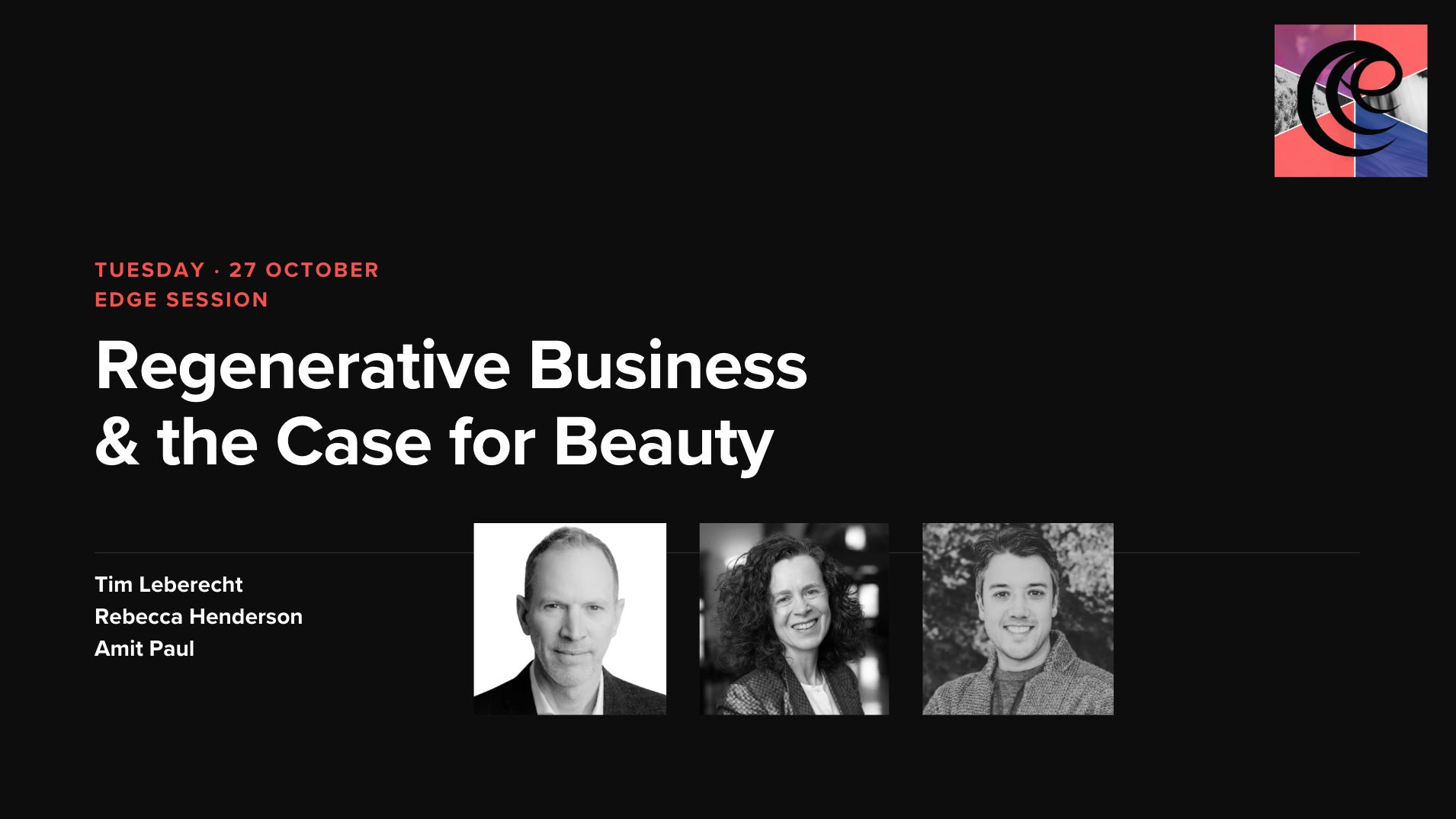
For our fifth Edge Session, we asked three of the most thoughtful voices on business what it should optimise for after efficiency. One closed by saying he has never seen an organisation change. Another said that doesn’t let any of us off the hook. Our conversation was with Rebecca Henderson, Amit Paul and Tim Leberecht, hosted by course founder Courtney Savie Lawrence with Nat Ortiz. You can see the full Virtual Edge season here. A quick read out is below!
For those who have been following Field Notes from Costa Rica, these conversations continue the work we began with Fellows during five days on campus, bringing together systemic design, applied AI, conscious leadership, and peace and conflict analysis. The Impact Innovation Course is hosted by the UPEACE Centre for Executive Education at the University for Peace, established by the UN General Assembly.
“Is it useful to talk about the transcendental? That’s my itch.” — Rebecca Henderson
“We’re at a point in the world where there are no viable solutions.” — Amit Paul
“There’s beauty in the dying old world, and it is dying.” — Tim Leberecht
Three speakers, three openings: one on the inner life of institutions, one on alignment, one on beauty at the end of an era. Between them they kept testing a single question. If business can’t save the world, what is it still for, and what is ours to do?
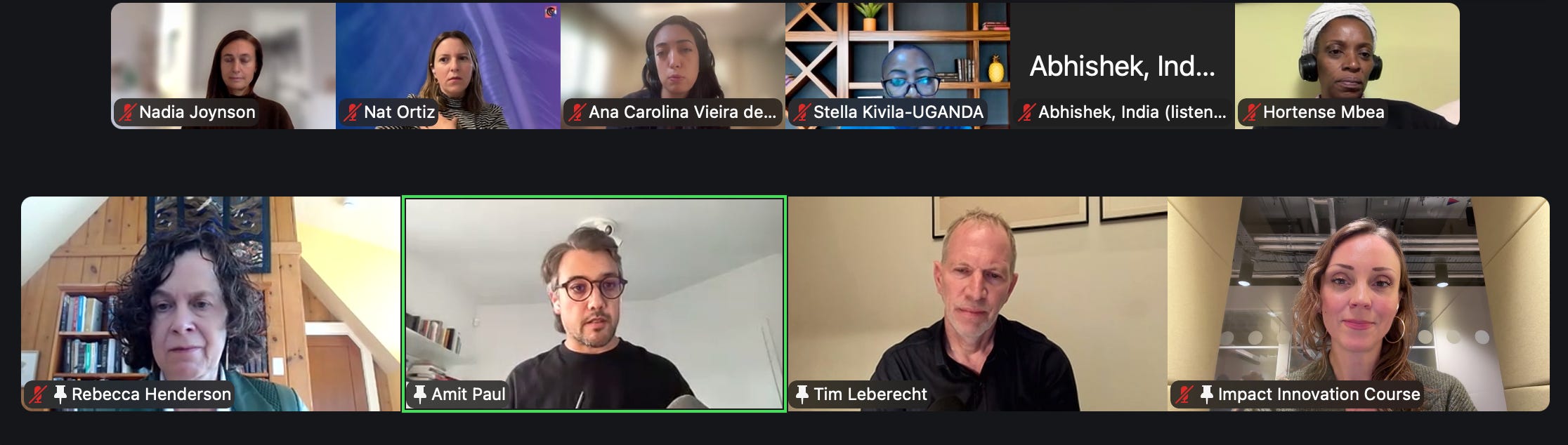
Rebecca is the John and Natty McArthur University Professor at Harvard and author of Reimagining Capitalism in a World on Fire. Amit co-founded Innrwrks and hosts the World of Wisdom podcast, and joined from Reykjavik. Tim co-founded the House of Beautiful Business and joined from Athens, which he called gritty, turbulent and very beautiful. Nat joined from Tbilisi, and participants from Geneva, Kampala, Addis Ababa, Mumbai, Montreal, Madrid, Colombia and beyond.
Once again Courtney located us in the Berkana Two Loops model: an incumbent system that may need hospicing, and emerging practices moving toward the mainstream. All three speakers are stewarding that shift. None of them pretended it is going well.
Three edges, one oscillation
As every week, each speaker started with an edge: something stretching them, or still unresolved.
Rebecca’s edge was the inner dimension. She has become less interested in business alone and more in the whole system it sits in, especially the interaction between the outer dimension of formal institutions and the inner dimension of individuals and groups. How do you talk about that inner dimension in a way that is actionable but still true? Then she named the itch that had broken into a meeting days earlier: is it useful to talk about the transcendental, or is it a mistake?
Amit’s edge was alignment. The question behind everything he does is how to transform business to create futures we want for our kids. He tries to live on a seesaw between responsibility and compassion, but inside business it is hard to hold both and know what is enough. His starting premise was blunt: from where we are now, there are no viable solutions.
Tim answered Rebecca before naming his own edge. His first instinct was that of course we must bring transcendence into business. Then he paused: maybe we shouldn’t talk about it, but experience it, since change comes from shared emotional experience more than good arguments. His edge is AI, which he called the ultimate optimiser and the razor blade of capitalism. Can there be such a thing as beautiful AI? If beauty can be found in the lion’s den, he said, that might be a battle worth fighting.
From the book to the monastery
Courtney asked Rebecca how her thinking has moved since Reimagining Capitalism. She is still proud of the book, she said: a grounded, fact-based case that firms can treat people with dignity, care for the environment and engage in politics constructively. Then she gave hundreds of talks to thousands of people, and got seriously concerned. She had assumed that showing leaders the economic case would be enough. It wasn’t, for her or for many others.
Her big realisation since then: corrosive outer institutions are mirrored by an inner dimension, the deep assumptions about who we are and what we value, in individuals, in groups and across society. Both matter equally. She has learned that you can shift a room. Give her 20 senior managers, half cognitive and half experiential, with deep listening and a hard look at the structure of capitalism, and people move. But that is 25 people at a time.
So no, there is no way back to how things were. That doesn’t mean there is no work. As civilisation ruptures, she said, some of us have to be the catalytic nuclei, the lighthouses, the monasteries that show another way through, both institutional and internal. We have the technology and resources that the survivors of the Black Death or the Second World War lacked. What we lack is imagination, relationality and connection. Sometimes she calls it plainly a spiritual crisis.
Simple, but not easy
Amit described how Innrwrks kept being pulled deeper. It began with leadership training, but kept being told: you’re here, fix those people, they’re the problem. So it moved into corporate structure, a five-year rabbit hole, then investment structures, another. Today it works with startups and scale-ups, and at the edges of enterprise, including helping a coalition of large industrial companies push net-zero knowledge through their supply chains without the extractive logic that usually comes with it.
He borrowed Nora Bateson’s reframe: the question for these times is not what can we do, but how can we find a way. Five years and 300 podcast episodes in, the theme he keeps meeting is separation, the belief that we live apart from each other, our bodies and the world. Much of the pathology of business lives there, he said, and financial markets have separated themselves most completely. Intimacy is the antidote, but it has a cost: people need to see how you conduct yourself day to day. The solutions are incredibly simple, he concluded. They are just not easy, especially in this moment.
Honesty, and beauty in the wreckage
Tim explained that the House of Beautiful Business began in 2016 with an ambition to stage the most romantic business conference the world had seen, with silent dinners, opera singers and football matches. It started with purpose and humanising technology, then moved from human-centred to life-centred, and now asks about interbeing and what it means to be a good citizen in a wider sense. Quoting Fernando Pessoa, he called beauty a name for something that does not exist, and beautiful business everything business is not yet, but could be.
He admitted to dark mornings, and to the cynicism that creeps in after years of holding hopeful space. Yet he said he is hopeful, because everything is breaking open. Citing the philosopher Bayo Akomolafe, he described beauty in the cracks: the old world is dying, and with it comes an almost erotic desire to create something new. (Hortense Mbea noted in the chat the old pairing of Eros and Thanatos, life and death. Amit added: and the continuation between them.)
Asked what people will be thirsty for next year, Tim answered in one word: honesty. Not “authenticity”, but directness and sincerity. At a dinner in Sofia, a business leader asked what we owe future generations and answered: stop being hypocritical. Our brands, our organisations and the stories we tell ourselves are often lies, and we are comfortable with that. Tim described a dual task for the House: carefully cleaning the rooms of the existing house while also tearing it down to build a new one. He is wary of a political pendulum swinging back without harvesting the lessons of the last six years. That is why the 2027 World Beautiful Business Forum in Athens will host houses of nihilism, cynicism, populism and transhumanism, to engage the ideologies he rejects rather than retreat into a comfortable island.
What keeps them going
Courtney then asked something we rarely ask faculty: what has given you strength personally when the work gets dark? She shared that the idea for this course came to her as an expat in Paris, watching events unfold in her home country from a distance. All three answered with unusual candour.
Amit quoted a conversation from the week before: it’s not difficult, it’s just painful. His recurring question is what it takes for him to stop, and the honest answer is a lot. What he aspires to now is not surrender but submission to something larger. As bleak as that sounds, he said, there is a lot of life there.
Rebecca said that after the book she lived for about two years with the feeling of a tsunami of suffering coming toward us. What helped was silence: a week-long Vipassana retreat every month for two years, and six to eight weeks a year since. She doesn’t live in that place anymore. She lives mostly in joy. There are many paths up this mountain, she said, but privileged Western culture has largely shut the mountain out of existence, and it is not very evident in Fortune 200 boardrooms.
Tim’s answer was people. After every gathering he is struck by how fascinated we are by each other. This summer he took his teenage daughter to a concert in Madrid with tens of thousands of others, and felt the collective effervescence of a pilgrimage. He had just recorded an episode of the House’s new podcast with June Cohen on The Great Remembering, about ancient practices of festival, ritual and physical challenge that we have forgotten. Going out into the world, he said, even an ugly one, is still the best medicine.
Kindness and math, or not business at all
Stella Kivila asked the practitioner’s question: how do you actually steward a shift inside an organisation that is used to the status quo? Rebecca described running Paul Polman’s strategic retreats in his early years at Unilever. It takes time, she said, but it is eminently possible, and it takes real resources: the top 1,000 people went through purpose workshops, flagship units were staffed with the best people and pushed hard, and there was real pushback in the room. Her summary: you need kindness and math. Inner work, purpose and authenticity, and also metrics, strategy, hiring and promotion. Polman could move in a moment from visionary to asking why Indonesian deodorant sales were down. It was love and power integrated, she said, and so many people on this wavelength are suspicious of power.
Amit picked up the same thread through Carol Sanford’s levels of things, processes, relationships and source: you have to stay connected across all of them at once. Then he left a provocation: if you can’t save anything, if all the work that needs doing is already being done, if you are not the chosen one, what is yours to do?
Tim closed with the sharpest line of the season so far. In all his consulting, with Fortune 500 companies, NGOs and small businesses, he has never seen an organisation change its core culture, despite everyone’s best efforts. They evolve and adapt at the edges, but their DNA holds. So the answer, he said, is not business, at least not as we know it. He would rather trust the arts in a time of radical imagination, and treat businesses as vehicles for beauty and community. The current structures? He is not sure they are worth our intervention.
Rebecca had the last word, and she held both. Amit is right that with eight billion people and a crisis centuries in the making, it is narcissistic grandeur to think any one of us can fix it. Tim is right that old structures are brutally hard to change; she spent twenty years of scholarship trying. But that doesn’t excuse us from doing something. Doing it with others, in community, rooted to source and done skilfully, is “like the best fun,” she said. It fills our soul’s purpose.
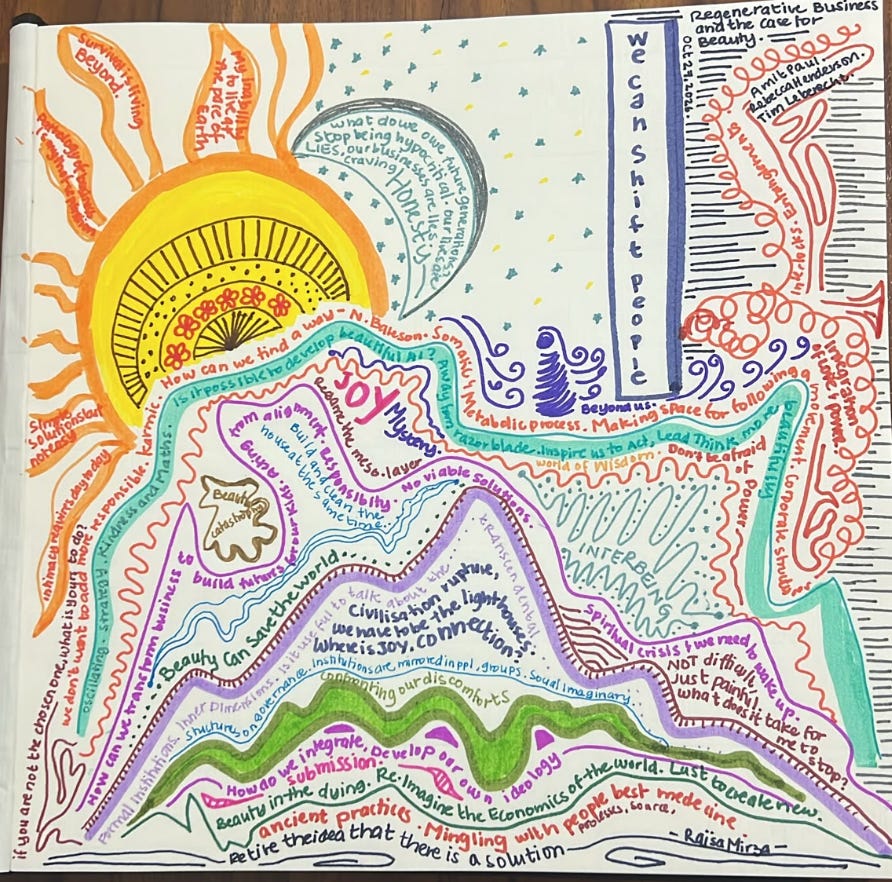
As the speakers left, Courtney shared the live graphic recording Raïsa Mirza had drawn through the hour, past midnight in Indonesia, with Joy sitting in the sunlight at its centre. Tim had just said to trust the arts. It felt like an answer.
From the floor: who gets to call themselves regenerative?
Irene Rivera, who has worked with impact enterprises in Guatemala and Central America for a decade, picked up Tim’s call for honesty. She sees many companies adopting the “impact” or “social enterprise” label to win clients. Is the same happening with “regenerative”? And are there clear criteria, or are we still co-creating what it means?
Tim said he hadn’t seen much cynical misuse of the word in his own community, though he expects it, as with every good idea that gets commodified into some new kind of “washing.” Even then, he argued, co-option still shifts the language and the culture. Rather than slapping fingers, he would highlight the genuine and honest examples. Amit was more wry: the joke goes that sustainability consultants opened their files one day and swapped in “regenerative.” His hope is that regeneration is infinitely complex, and if you take the inquiry seriously, it does its work on you. Some companies that never use the word practise it better than those shouting from the mountaintop. And you can feel it when you meet it, he said. It’s not mind stuff.
The chat took up the same question from the other side. Rebecca wrote that she loved Tim’s answer but still believes we need metrics, and regulation, if it can be created democratically and effectively. Amit offered a reframe: metrics as portals, pointing to the continuation of a journey rather than a fixed point. Manuela Guzman noted that no global body defines regeneration, so we may each be defining it from our own experience. Nat shared an RSA report she worked on with former colleagues that attempts some of that defining.
A second debate ran alongside it, on inner work versus systems change. Helen Millar, an actress and founder, agreed with Rebecca that long-term cultural shift needs an appetite for individual work, and suggested the upside of everything falling apart is that the appetite grows. Lucía Hernández pushed back: if we wait for personal work and rising consciousness, we will run out of time, so we also need to shift the paradigm through stories, content and talks. Amit replied that business can be personal work, and personal work can be business, and later added his own way of holding urgency: “slow is smooth, smooth is fast.” Nadia Joynson offered a hopeful counterpoint: young people are already tearing down the house, and about a quarter of the class she taught the day before already knew Nonviolent Communication. We may be hospicing a generation of work, she wrote, while the next one builds alternatives.
Five patterns from the hour
1. The economic case was never enough. Rebecca’s hundreds of talks, Amit’s clients asking him to “fix those people,” Tim’s Sofia dinner on hypocrisy: knowing better has not made business do better. The missing piece is the inner dimension, the assumptions about who we are and what we value.
2. Change needs both kindness and math. Inner work without strategy, metrics and hiring stays a retreat. Strategy without love stays extraction. Rebecca’s Unilever story and Amit’s Carol Sanford levels say the same thing: leaders have to oscillate between the two, skilfully, and stop being suspicious of power.
3. Honesty may matter more now than purpose. Purpose was the calling card of the last decade. Tim hears people craving directness instead, and Irene’s greenwashing question showed why: every good word gets co-opted. Whether the answer is metrics and regulation or a felt sense of the real thing, the room did not fully agree.
4. The speakers disagreed about whether business can change, and that was the point. Tim has never seen an organisation change its DNA and would rather trust the arts. Rebecca spent twenty years finding the same thing and still says we must act. Amit asks what is yours to do if you are not the chosen one. All three are working on business anyway.
5. Joy is a strategy, not a reward. Rebecca lives mostly in joy after years of silent retreat. Tim finds medicine in crowds and concerts. Amit finds life in submission. None of them treated hope as a forecast. Each treated joy and connection as what makes the long work possible.
Across five Edge sessions, a single question keeps sharpening. We asked who decides the future, who “we” is, who pays for the part nobody sees, and whose time we are keeping. This week: if you are not the one who saves it, what is yours to do?
Questions we’re carrying forward - that came up from course participants and fellows in the session
Who decides what counts as regenerative, and can we build criteria without freezing a living practice into a checklist?
Is it useful to talk about the transcendental in business, or do we need to experience it instead?
How do founders steward a shift inside institutions that are comfortable with the status quo?
If organisations rarely change their DNA, where should people who want change put their energy: inside, alongside, or outside them?
Go deeper: resources shared in the session
Innrwrks, Amit Paul’s company: https://innrwrks.com
Reimagining Capitalism, Rebecca Henderson: https://reimaginingcapitalism.org
House of Beautiful Business, Tim Leberecht: https://houseofbeautifulbusiness.com
Regenerative Futures: from sustaining to thriving together, RSA report (shared by Nat Ortiz): https://www.thersa.org/reports/regenerative-futures-from-sustaining-to-thriving-together
The Great Remembering by June Cohen, on ancient practices for today (mentioned by Tim)
Nora Bateson and Carol Sanford, both referenced by Amit
With thanks to Rebecca Henderson, Amit Paul and Tim Leberecht, and to everyone who brought questions, stories and resources, especially Irene, Stella, Helen, Lucía, Nadia, Manuela and Hortense, and to Raïsa for drawing the whole hour. Written with AI assistance from the session recording. The open fireside that followed in Kolab, co-hosted by Fellows Irene Rivera and Ana Carolina Vieira de Andrade, was not recorded, and those conversations stay in the room.
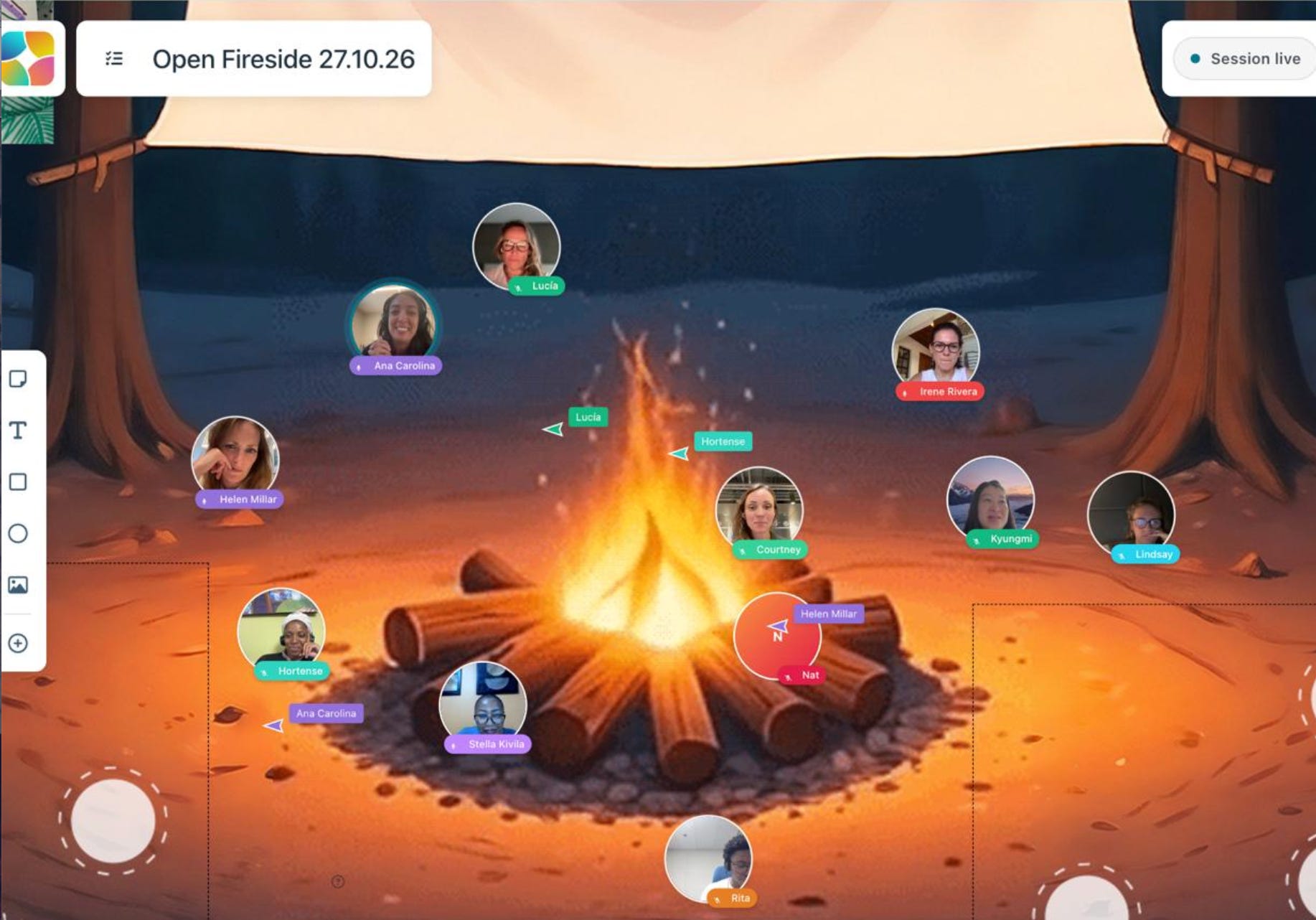
With thanks to all of the faculty, and to everyone who brought questions, stories and resources. Written with AI assistance from the session recording. The open fireside that followed in Kolab, was not recorded, and those conversations stay in the room.
This week: Narrative Power: Storytelling for Climate and Change (November 3) Tim said we should trust the arts. Next week we test what stories can and can’t do.
Interested to join? Participant registrations open and ongoing now through December 1st. More on how to register here. And ready to stay up to date on the latest? Join our LinkedIn community here.